
TDEE Calculator: Free Tool to Calculate Your Daily Calorie Needs for Weight Loss, Maintenance, or Muscle Gain
Last Updated: July 2026 ·
Your Profile
Calculation Method
Activity Level
Light: Exercise 1-3 times/week
Select Primary Goal
Daily Calorie Target
Our free TDEE calculator estimates your total daily energy expenditure using established predictive equations and your personal details: age, biological sex, height, weight, and activity level. In under a minute, you’ll get a personalized daily calorie target for weight loss, maintenance, or muscle gain.
Know how many calories your body burns each day before you change your diet.
Unlike calculators that just display a number, ours explains how your estimate was calculated, why it changes over time, and exactly what to do with it. No sign-up, no hidden fees.
Table of Contents
What Is TDEE?
TDEE (Total Daily Energy Expenditure) is the estimated number of calories your body burns in a day combining resting metabolism, digestion, daily movement, and exercise. It’s the number to know before setting a weight loss, maintenance, or muscle-gain target.
TDEE combines four things: the calories you burn just staying alive, the calories spent digesting food, the calories used in everyday movement, and the calories burned through planned exercise. Add them up and you get your daily calorie budget.
Example: Sarah is 35 years old; weighs 170 lb; is 5’6″ tall; walks about 8,000 steps a day; and lifts weights three times a week. Her estimated TDEE comes out to roughly 2,250 calories. For gradual weight loss, she might start around 1,900 calories a day, then track her average weight over two to four weeks before adjusting further.
Your TDEE isn’t fixed; it shifts as your weight, activity, and body composition change.
Is This Calculator Right for You?
Who This Calculator Is For
- Adults working toward gradual, sustainable weight loss
- Anyone trying to maintain their current weight
- Strength trainees and athletes estimating their calorie needs
- Beginners who have never calculated their calorie needs before
- Anyone building a meal plan around an estimated calorie target
When to Get Personal Guidance
- Pregnancy or breastfeeding
- Children and teens
- Current or past eating disorders
- Medical conditions that may significantly affect metabolism
If any of these apply to you, consider speaking with a doctor, registered dietitian, or another qualified healthcare professional for guidance tailored to your individual situation.
What Is My TDEE?
Your TDEE is unique to you; it depends on your age, sex, height, weight, and activity level, so there’s no single “average” number. Calculating it yourself with the tool above is the only accurate way to find it.
Two people the same height and weight can still have different TDEEs if their muscle mass, age, or activity differs. That’s why generic advice like “eat 2,000 calories a day” doesn’t hold up; it isn’t built around your numbers.
How to Calculate TDEE
First estimate your Basal Metabolic Rate (BMR) calories burned at complete rest, then multiply it by an activity factor reflecting your typical day.
Daily Calories Burned = Resting Calories + Daily Activity
A BMR of 1,650 for someone moderately active might produce a TDEE around 2,550 calories.
adults
(Mifflin et al., 1990) ↗
reference
muscle mass
(Cunningham, 1980) ↗
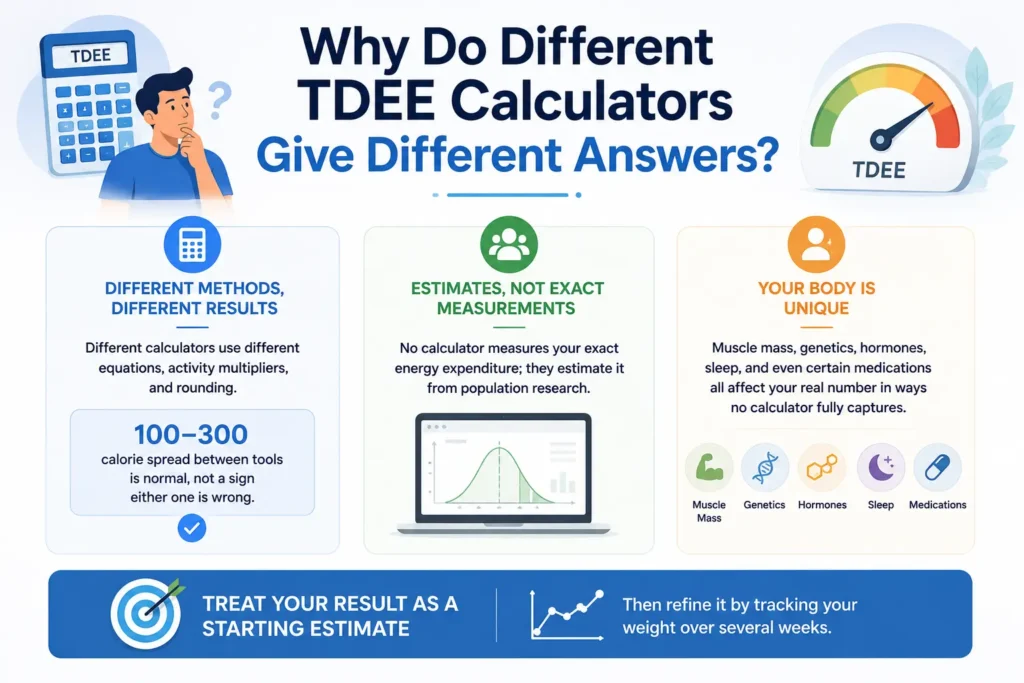
Why Do Different TDEE Calculators Give Different Answers?
Different calculators use different equations, activity multipliers, and rounding. A 100–300 calorie spread between tools is normal, not a sign either one is wrong.
No calculator measures your exact energy expenditure; they estimate it from population research. Muscle mass, genetics, hormones, sleep, and even certain medications all affect your real number in ways no calculator fully captures. Treat your result as a starting estimate, then refine it by tracking your weight over several weeks.
Find Your Next Step
What’s your goal?
1. Lose Fat
How much weight you want to lose can help determine your approach.
- Around 5 lb: A small calorie deficit and a few minor daily adjustments may be enough.
- Around 10 lb: A moderate deficit is usually more appropriate. Check your progress and reassess every 2–3 weeks.
- 20 lb or more: A moderate deficit can be maintained over a longer period. Recalculate your TDEE after every 10–15 lb lost, as your calorie needs will change with your weight.
2. Maintain Your Weight
To maintain your current weight, start by eating around your estimated TDEE.
- Track your weekly average weight rather than focusing on daily fluctuations.
- If your weight consistently trends upward or downward, make a small adjustment to your calorie intake.
3. Build Muscle
Building muscle usually requires eating in a small calorie surplus above your TDEE.
- Combine your nutrition plan with regular resistance training.
- Make sure you are getting adequate protein.
- Review your progress and adjust your calorie intake every 3 to 4 weeks if needed
Choose Your Goal
Your estimated TDEE gives you a starting point. What you do next depends on your goal.
Weight Loss
Eat below your TDEE
Create a sustainable calorie deficit while preserving muscle.
Maintenance
Eat close to your TDEE
Track your weekly weight and adjust only when needed.
Muscle Gain
Eat slightly above your TDEE
Support your training with adequate protein and recovery.
Progress isn’t always linear
Daily changes in weight caused by water and sodium are completely normal. Judge your progress over weeks, not individual days.
The Four Components of TDEE
- Basal Metabolic Rate (BMR): energy for essential functions like breathing and circulation; usually the largest share of TDEE.
- Thermic Effect of Food (TEF): energy spent digesting food; protein has the highest thermic cost.
- NEAT (Non-Exercise Activity): everyday movement like walking, cooking, and chores. Easy to underestimate.
- EAT (Exercise Activity): calories burned through planned workouts.
Choosing the Right Activity Level
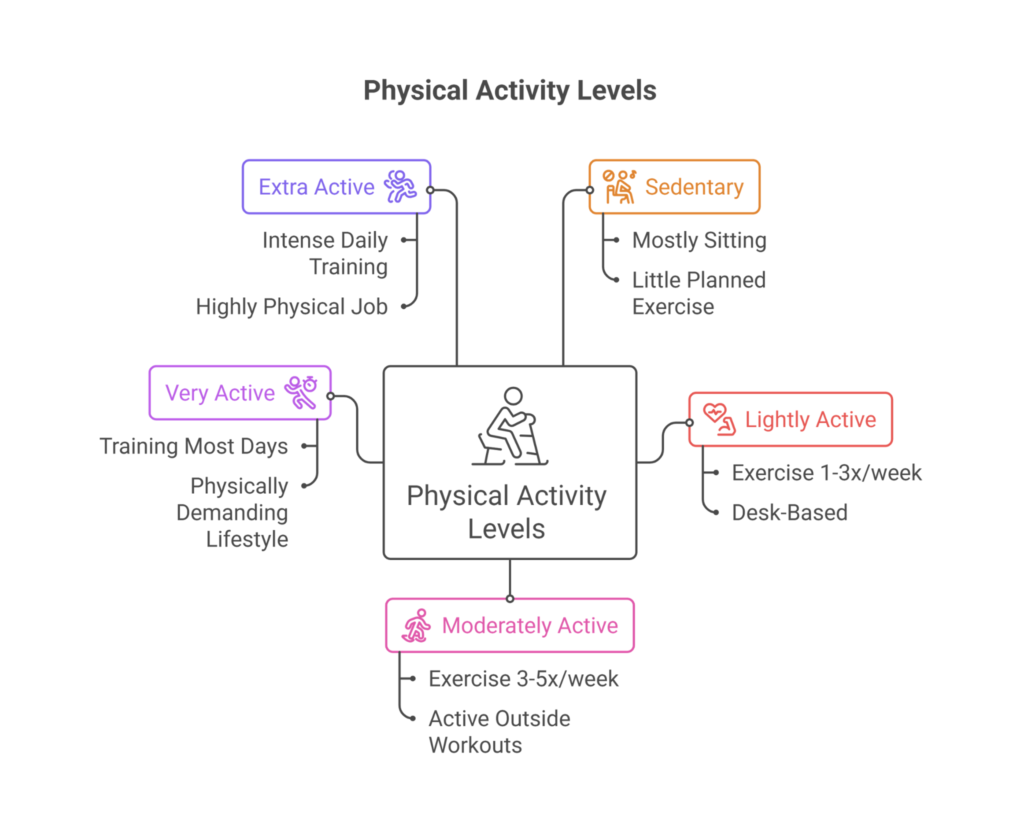
Choose your level based on your whole day
Your workouts are only one part of your overall activity. Click each factor to see what else matters.
Your work can make a big difference.
Spending most of the day at a desk is very different from working in a physically demanding job, even if both people follow the same workout routine.
Common Mistakes
Your TDEE is a useful starting point, but a few common mistakes can make the estimate less useful.
Don’t judge your activity level by one workout.
Your activity level should reflect your whole day, including your work, daily movement, time spent sitting, and planned exercise.
Think of your TDEE as a starting estimate. Use your actual results over time to decide whether your calorie intake needs adjusting.
Turn Your TDEE Into a Full Nutrition Plan
Calories tell you how much to eat; macros tell you what to eat it as. Once you know your TDEE, our macro calculator splits that number into daily protein, carb, and fat targets. Protein generally stays fairly constant across goals, while carbs and fat shift depending on whether you’re cutting, maintaining, or bulking.
If you want a more precise resting-metabolism figure first, our BMR Calculator isolates that number on its own, and our calorie deficit calculator can help you fine-tune exactly how aggressive your cut should be.
Why You Can Trust This Calculator
This calculator uses established predictive equations that have been validated in peer-reviewed nutrition research not proprietary guesswork. Every explanation on this page is designed to help you understand how your TDEE estimate is calculated and what the result means, not simply display a number.
Your result should be treated as a practical starting estimate, not an exact measurement. Individual calorie needs can vary based on factors such as body composition, daily activity, and changes in routine.
The information on this page is based on published research and guidance from recognized nutrition and health organizations. We review and update the content periodically as relevant research and guidance evolve. You can see the Last Updated date at the top of the page.
Frequently Asked Questions
TDEE is the calories your body burns daily. For weight loss, most people eat below their estimated TDEE while keeping protein and activity steady, then adjust based on real results.
Calculate your BMR with a formula like Mifflin-St. Jeor, then multiply by an activity multiplier reflecting your typical day. Our calculator does this automatically from your stats.
Higher daily steps raise expenditure, but your full TDEE still depends on age, sex, height, weight, and overall activity. Use the calculator above for a number personalized to you.
Yes, generally. A moderate deficit is usually easier to sustain than an aggressive one, especially paired with adequate protein and strength training.
A 500-calorie deficit is a common starting point, but the right number depends on your body size, activity, and goals; smaller deficits are often easier to maintain.
They use validated equations, so they’re a solid starting estimate. Refine yours by tracking weight over several weeks and adjusting as needed.
Yes, for most healthy adults. Confirm it by monitoring weight for a few weeks and adjusting if it trends up or down unintentionally.
References & Sources
The equations and information on this page are based on published research and guidance from recognized health and nutrition organizations.
Research Behind the Equations
A New Predictive Equation for Resting Energy Expenditure in Healthy Individuals
Mifflin MD, St Jeor ST, et al. American Journal of Clinical Nutrition, 1990.
A Reanalysis of the Factors Influencing Basal Metabolic Rate in Normal Adults
Cunningham JJ. American Journal of Clinical Nutrition, 1980.
Nutrition & Health Guidance
Academy of Nutrition and Dietetics
Nutrition Care Manual
American College of Sports Medicine
Guidelines for Exercise Testing and Prescription
National Institutes of Health
Nutrition and health information
U.S. Department of Agriculture
Nutrition and dietary guidance
For Educational Purposes Only
This calculator provides an estimate of your daily calorie needs based on established predictive equations. It is intended for general educational and informational purposes only and should not be considered medical or personalized nutrition advice.
Individual calorie needs can vary based on factors such as age, body composition, activity level, health conditions, medications, and other personal circumstances. If you have a medical condition, are pregnant or breastfeeding, have a history of disordered eating, or need personalized nutrition guidance, consider consulting a qualified healthcare professional or registered dietitian.